
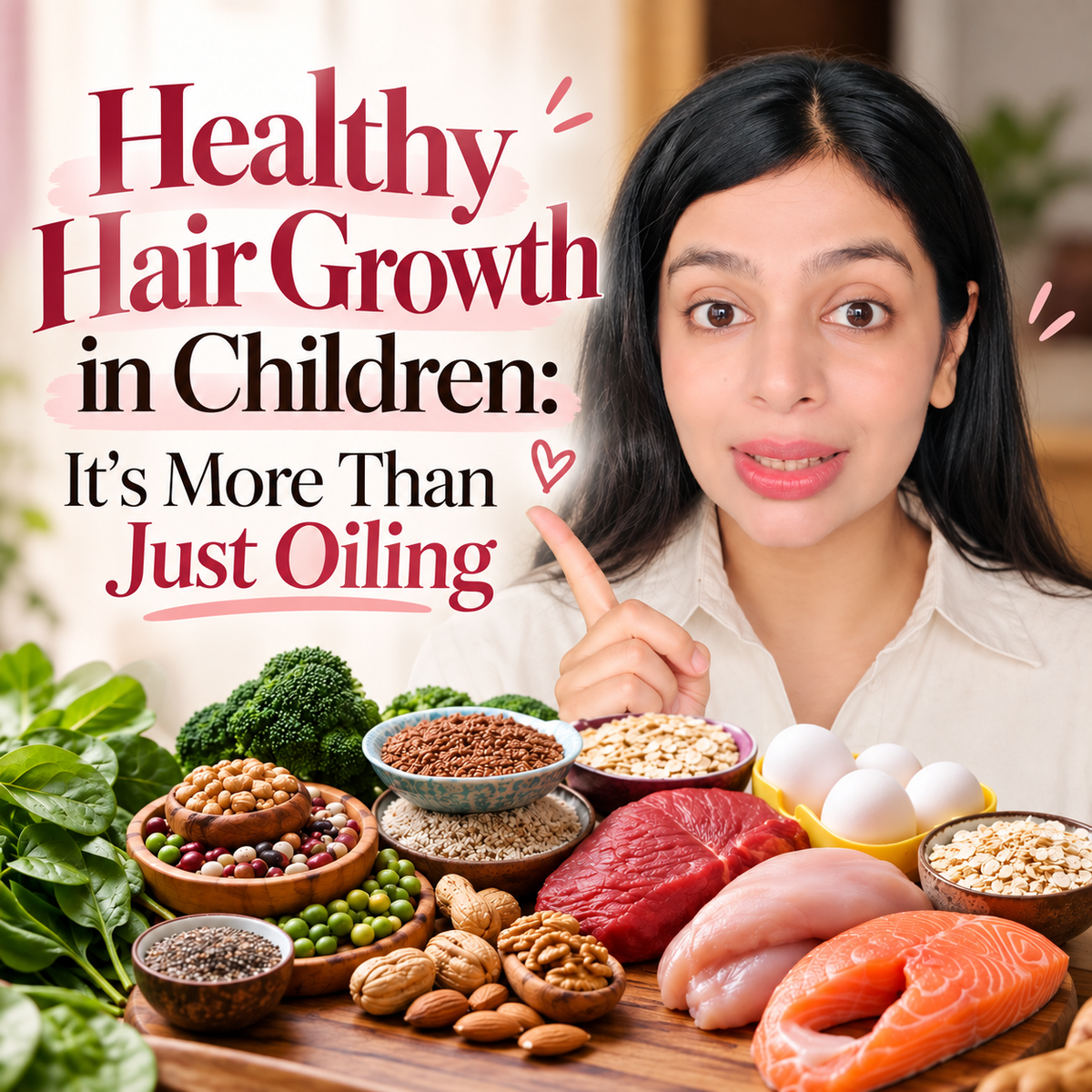
Healthy Hair Growth in Children: It’s More Than Just Oiling
As parents, we often associate healthy, thick hair with regular oiling. Oiling has certainly been a traditional part of hair care in many Indian households, but healthy hair growth is not determined by oiling alone.
A child’s hair health is influenced by several factors — including nutrition, genetics, overall health, scalp hygiene and everyday hair-care practices. The goal should not be to make every child’s hair look “thicker,” but rather to create the right environment for healthy hair and scalp while respecting the fact that every child has a naturally different hair density and growth pattern.
Here are some simple, practical ways parents can support healthy hair growth.
1. Start with nutrition: Hair needs nourishment from within
Hair is made primarily of a protein called keratin, so adequate nutrition is an important part of maintaining healthy hair.
A balanced diet should regularly include protein-rich foods, such as:
- Eggs
- Paneer and other dairy products
- Dal and beans
- Curd
- Nuts and seeds, where age-appropriate and safe
- Fish, chicken or other protein sources, depending on the family’s diet
Iron and other micronutrients are also important. Include a variety of green leafy vegetables, colourful fruits, vegetables, legumes and seeds in your child’s diet.
It is important, however, not to start “hair growth” supplements on your own. Nutritional deficiencies can contribute to hair loss, but taking excessive amounts of certain vitamins or minerals can also be harmful. If you are concerned about your child’s diet or hair growth, discuss it with your paediatrician before giving supplements.
2. Oiling can be gentle — but more oil doesn't mean more growth
A gentle oil massage can be a pleasant part of a child's grooming routine. It may help condition the hair and make the routine enjoyable, but there is no need to vigorously massage the scalp or leave large amounts of oil sitting on it for long periods.
Think of oiling as a hair-care practice rather than a guaranteed hair-growth treatment.
The key is gentleness. Avoid aggressive rubbing, scratching or pulling, particularly if your child's scalp is sensitive.
If your child develops itching, redness, scaling or pimples on the scalp, don't simply apply more oil. The underlying cause may need to be evaluated.
3. Keep the scalp clean
A healthy scalp needs to be kept clean.
Use a mild shampoo appropriate for your child's age and hair type, and gently massage the shampoo into the scalp rather than aggressively rubbing the entire length of the hair.
After washing, rinse thoroughly. For children with dry or curly hair, a suitable conditioner can help reduce tangling and breakage. Dermatologists also recommend being gentle when drying and combing children's hair.
There is no universal rule that every child needs to wash their hair on a particular number of days. Frequency can depend on the child's age, scalp, hair type, activity level and whether the scalp becomes sweaty or oily.
4. Be gentle with wet hair
Wet hair can be more vulnerable to breakage, so avoid vigorous towel rubbing or aggressive brushing.
Instead:
Wash → gently squeeze out excess water → pat or wrap gently → detangle carefully.
A wide-toothed comb can be useful, particularly for curly or easily tangled hair. Work through tangles patiently rather than pulling through them.
Remember: less pulling = less breakage.
5. Avoid hairstyles that pull on the scalp
This is one area where parents often underestimate the impact.
Tight ponytails, buns, braids or other hairstyles that repeatedly pull on the hair can cause traction alopecia, a form of hair loss caused by prolonged tension on the hair follicles.
Children can develop this too. Early signs can include broken hairs around the hairline or thinning in areas where the hair is repeatedly pulled.
A simple rule for parents:
If a hairstyle hurts, it is too tight.
Choose loose, comfortable hairstyles and change them regularly rather than keeping the hair under constant tension.
6. Minimise excessive heat and chemical treatments
Children generally don't need elaborate styling routines.
Frequent use of:
- Hair straighteners
- Curling irons
- High-heat blow drying
- Chemical straightening
- Relaxing or colouring treatments
can contribute to hair damage and breakage. Dermatologists recommend limiting heat and avoiding unnecessary chemical treatments, particularly for children's hair.
Healthy children's hair doesn't need to be perfectly styled every day.
Natural, comfortable and low-maintenance is often best.
7. Don't worry about split ends — simply trim damaged ends
Split ends are a sign that the hair shaft has become damaged. A haircut or trim can remove the visibly damaged portion and make the hair look healthier.
However, trimming the ends does not make hair grow faster from the scalp.
Hair growth happens at the follicle, underneath the scalp. So regular trims are primarily about maintaining the appearance and manageability of the hair, not increasing the biological rate of growth.
8. Remember that genetics matter
This is perhaps the most important message for parents.
Not every child is going to have the same hair density, thickness or growth rate.
Some children naturally have fine hair. Some have thick hair. Some have straight hair, while others have curly or wavy hair. Hair texture and density can change as children grow.
Comparing your child's hair with another child's hair can create unnecessary anxiety.
Instead of asking, “Why isn't my child's hair as thick as hers?”, look at the bigger picture:
- Is the child growing and developing normally?
- Is the scalp healthy?
- Is there excessive shedding?
- Are there bald patches?
- Is the hair breaking?
- Is the child getting a balanced diet?
These questions are much more meaningful than simply judging hair thickness.
When should parents be concerned?
Some amount of normal hair shedding is expected. But sudden, excessive or unusual hair loss deserves attention.
Speak with your paediatrician or a dermatologist if you notice:
- Sudden increase in hair shedding
- Clearly visible bald patches
- Receding or thinning hairline
- Persistent scalp itching or flaking
- Redness, crusting or sores on the scalp
- Significant hair breakage
- Hair loss following a significant illness or fever
- Hair that doesn't seem to be growing back
- Any noticeable change that concerns you
Hair loss in children can have several different causes, including scalp infections, tight hairstyles and temporary shedding after physical stress or illness. Identifying the cause is more important than simply trying different oils or hair products. HealthyChildren.org
The Bottom Line
Healthy hair growth is not about finding one magical oil, shampoo or hair-growth product.
It is about looking at the whole child.
🥚 Give them adequate protein and a varied diet.
🥬 Include iron- and vitamin-rich foods.
🫧 Keep the scalp clean without over-treating it.
💆🏻♀️ If you oil, massage gently — never aggressively.
🚫 Avoid tight hairstyles, excessive heat and unnecessary chemical treatments.
✂️ Trim damaged or split ends when needed.
❤️ And remember that every child's natural hair density and growth pattern is different.
Most importantly, healthy hair doesn't have to mean thick hair. Our goal should be a healthy scalp, healthy hair strands and a well-nourished, thriving child — not achieving a particular standard of hair density.
If you notice sudden or excessive hair fall, bald patches, persistent scalp symptoms or a significant change in your child's hair growth, consult your paediatrician or dermatologist rather than relying solely on home remedies.
This article is intended for general educational purposes and does not replace an individual consultation with a paediatrician or dermatologist.

Leave a comment
This site is protected by hCaptcha and the hCaptcha Privacy Policy and Terms of Service apply.